Senenmut
Egyptian, Classical, Ancient Near Eastern Art
On View: Old Kingdom to 18th Dynasty, Egyptian Galleries, 3rd Floor
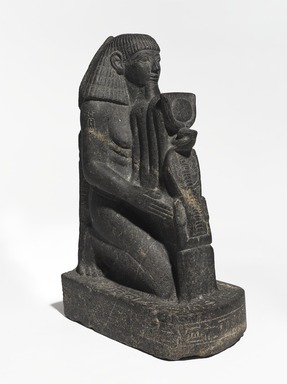
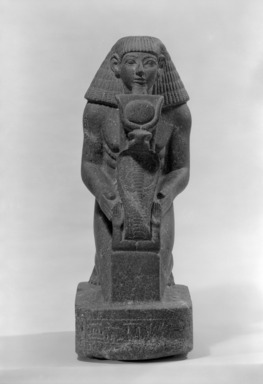
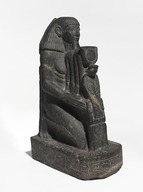
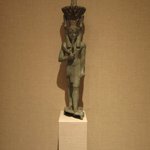
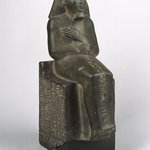
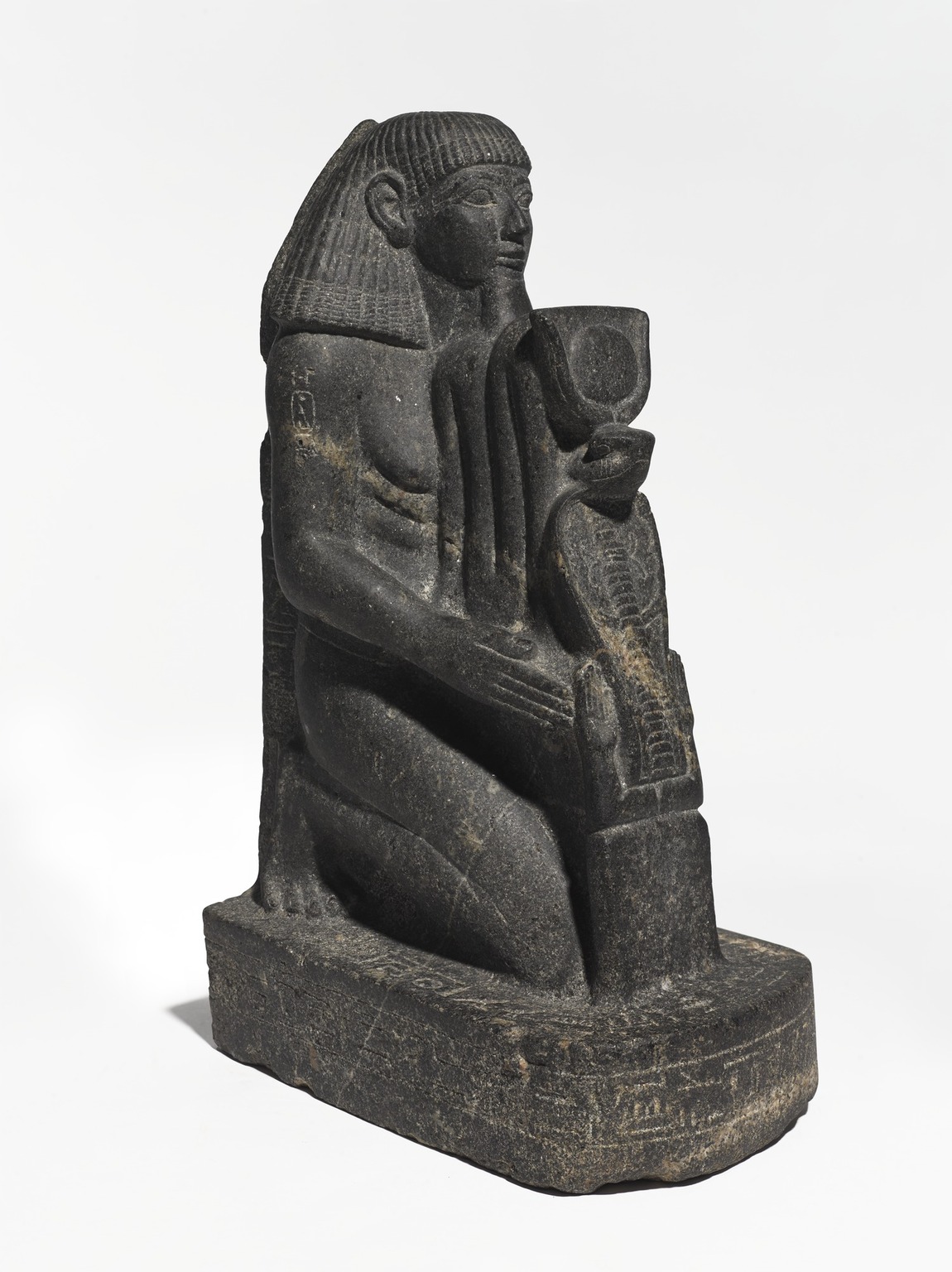
Occasionally an innovative artist enhanced a traditional sculptural form. This statue of Senenmut—an important official during the joint reign of Queen Hatshepsut and King Thutmose III—appears in the classic kneeling pose known since the Fourth Dynasty (circa 2625–2500 B.C.E.). Old and Middle Kingdom kneeling statues show a subject with his hands resting on his thighs or holding a pair of tiny round vessels. The sculptor of this piece, however, depicted Senenmut presenting a complex object: a cobra resting in a pair of upraised arms, wearing cow horns with a sun-disk. Egyptologists interpret this image as a cryptogram of Hatshepsut’s throne name (Ma`at-ka-re).
The sculptural form of a kneeling man holding an intricate symbolic image first appeared in statues of Senenmut and continued for hundreds of years. Perhaps this new type of statue was the product of Senenmut’s imagination, as interpreted by a skilled and receptive artist.
MEDIUM
Granodiorite with granite vein
DATES
ca. 1478–1458 B.C.E.
DYNASTY
Dynasty 18
PERIOD
New Kingdom
DIMENSIONS
18 3/4 × 7 × 11 1/2 in., 67.5 lb. (47.6 × 17.8 × 29.2 cm, 30.62kg)
(show scale)
ACCESSION NUMBER
67.68
CREDIT LINE
Charles Edwin Wilbour Fund
CATALOGUE DESCRIPTION
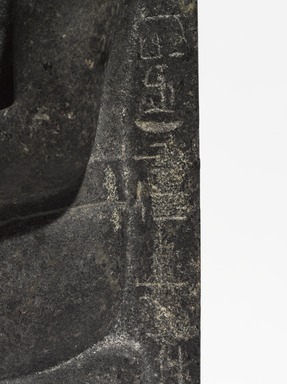
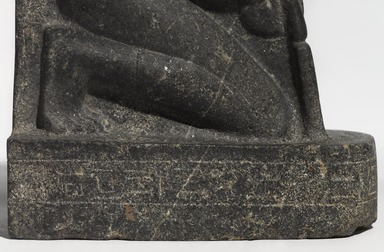
Kneeling statue in dark grey granite representing Senenmut proferring symbol composed of the "ka" hieroglyph surmounted by a cobra with cow horns and sun disk, the whole forming a rebus of the name Makara, that of Hatshepsut. Senenmut wears a wide striated wig covering his shoulders, a short beard, and a kilt from the waist to just above the ankles. One line of text round base, one line on top of base left side, front, right side; three columns of text on back-pillar which ends on triangular top inclined toward back of Senemut's head. One column on left side of back pillar and one column on right side; cartouche of Makara on right upper arm.
Condition: Figure perfect, but inscription shows erasures and slight damage in several places. Base chipped.
CAPTION
Senenmut, ca. 1478–1458 B.C.E. Granodiorite with granite vein, 18 3/4 × 7 × 11 1/2 in., 67.5 lb. (47.6 × 17.8 × 29.2 cm, 30.62kg). Brooklyn Museum, Charles Edwin Wilbour Fund, 67.68. Creative Commons-BY (Photo: , 67.68_threequarter_left_PS9.jpg)
IMAGE
67.68_threequarter_left_PS9.jpg., 2018
"CUR" at the beginning of an image file name means that the image was created by a curatorial staff member. These study images may be digital point-and-shoot photographs, when we don\'t yet have high-quality studio photography, or they may be scans of older negatives, slides, or photographic prints, providing historical documentation of the object.
RIGHTS STATEMENT
Creative Commons-BY
You may download and use Brooklyn Museum images of this three-dimensional work in accordance with a
Creative Commons license. Fair use, as understood under the United States Copyright Act, may also apply.
Please include caption information from this page and credit the Brooklyn Museum. If you need a high resolution file, please fill out our online
application form (charges apply).
For further information about copyright, we recommend resources at the
United States Library of Congress,
Cornell University,
Copyright and Cultural Institutions: Guidelines for U.S. Libraries, Archives, and Museums, and
Copyright Watch.
For more information about the Museum's rights project, including how rights types are assigned, please see our
blog posts on copyright.
If you have any information regarding this work and rights to it, please contact
copyright@brooklynmuseum.org.
RECORD COMPLETENESS
Not every record you will find here is complete. More information is available for some works than for others, and some entries have been updated more recently. Records are frequently reviewed and revised, and
we welcome any additional information you might have.